A listening party, but outside. In the afternoon light, the voice of Mahmoud Abdelaziz trails down the street, soundtracking the sunset. It feels like you’re coming home from work in Khartoum and your uncle is playing his favorite songs, but you’re actually in Oakland listening to Haneen Sidahmed’s Sudan Tapes Archive.
When Sidahmed’s family first moved to the US, they had an old camry and many Sudanese cassette tapes. “Playing cassettes in that car is my first musical memory,” the Sudanese American audiovisual archivist and multidisciplinary artist tells OkayAfrica. “Ahmed Al Mustafa’s album Ya Rayi3 was on rotation all the time and I had memorized all of the tracks.”
As is common for people living in the diaspora, music was a bridge to the home they had left behind. Al Mustafa, for example, sings about Omdurman, Sidahmed mother’s hometown. Sidahmed grew up loving Sudanese music long before she understood the depth of its poetry or the diversity in its traditions.
Before founding the Sudan Tapes Archive, a digital archive dedicated to preserving Sudanese analog media, she was a Tumblr kid who liked to collect vintage photos of Sudan that she found in Facebook forums. “They were very meaningful to me, because I wasn’t able to access Sudanese heritage easily, because of sanctions,” she says. “You know, Sudan doesn’t have this huge entertainment or cultural industry that can be exported.”
The lack of a larger entertainment industry has meant that much Sudanese media gets left behind in the digital age as younger generations lose the analog tradition. Analog music did not migrate to digital spaces, which has created a gap in the genres different Sudanese generations listen to. Sudanese hip hop is easy to access online, but what about the genres of the 20th century?
Sidahmed could not find the songs of her childhood on streaming platforms, so when she needed a distraction during the pandemic lockdown, she learned how to digitize her father’s old cassettes.
She started off with a $20 cassette-to-USB converter and YouTube videos. With time, she learned more about restoration and repairing the sound of degraded tapes, venturing into niche corners of the internet where passionate old white men somewhere in Wisconsin or Mississippi had written detailed explanations of how to digitize cassette tapes. Sidahmed gratefully followed their instructions.
instructions.

With every new song, Sidahmed’s personal collection of her parents’ tapes and cassettes she had picked up in Sudan grew into a larger online archive that now includes community donations and the collections of other diasporic families. When war broke out in Khartoum in 2023, this archive became more than a nostalgic project for diaspora kids.
“When the war first happened, I could not engage with the music,” she remembers. “Once the initial shock wore off, I started seeing it as a larger purpose. The war is also a war on collective memory, so this work is a small way of preserving and restoring the memory that is being actively erased.”
Over the past three and a half years, national museums have been looted and libraries burnt down. Most recently, archeologists have warned that the ancient Pyramids of Meroë are rapidly declining due to neglect. “People themselves are huge repositories of memory and history,” says Sidahmed. “We are such an oral culture, so the loss of human life is also a loss of story.”
sudan tapes archive · Hanan Al Neel – Bilad Al Noor | حنان النيل – بلاد النور
“The more I learn the more I understand how little I know of what even encompasses Sudanese music tradition,” says Sidahmed, recognizing that the music she archives is a specific segment of a vast repertoire. “So much gets left out of the traditional canon, like music from Darfur, South Sudan or the East. I need a ten person Sudanese music history team to even begin to scratch the surface.”
On her deep dives, Sidahmed has found curious historical facts that connect Sudanese music to a wider global tradition. For example, Mahmoud Abdelaziz’s album Sakat Al-Rabab (1995) was recorded by a Russian orchestra which had learned to play Sudanese music. And a lot of Sudanese violinists at the time were taught by North Korean orchestra teachers who came to Sudan.
sudan tapes archive · 04. marrat al ayaam – مرت الايام
Most of all, Sidahmed has witnessed how intimately people engage with music as a grounding force for their memories. “Music is an outward expression of your heart,” she says. “You can get a sense of someone’s world through the music they listen to.” From associating a certain song with a bygone love, a home or a political moment, a lot of Sudanese music is inspired by yearning.

At Sidahmed’s listening parties and community events, people get to exchange these associations while discovering music they would not otherwise have found. She invites people to engage passively while they mingle, or more actively at listening stations, and gives them guiding questions to spark conversation.
“Music in Sudan is a communal listening practice,” she says. “If you were a family you had one tape deck and you’d all listen to one tape.”
sudan tapes archive · kadarawiya | كدراوية
As she works to engage more people, Sidahmed hopes to inspire more Sudanese to digitize their analog media and archive as many stories and cultures as possible. She would like to help artists preserve their bodies of work, and teach people her DIY archive process.
“Despite the destruction, so much lives on in people’s homes, because they are taking ownership of their heritage,” she says.
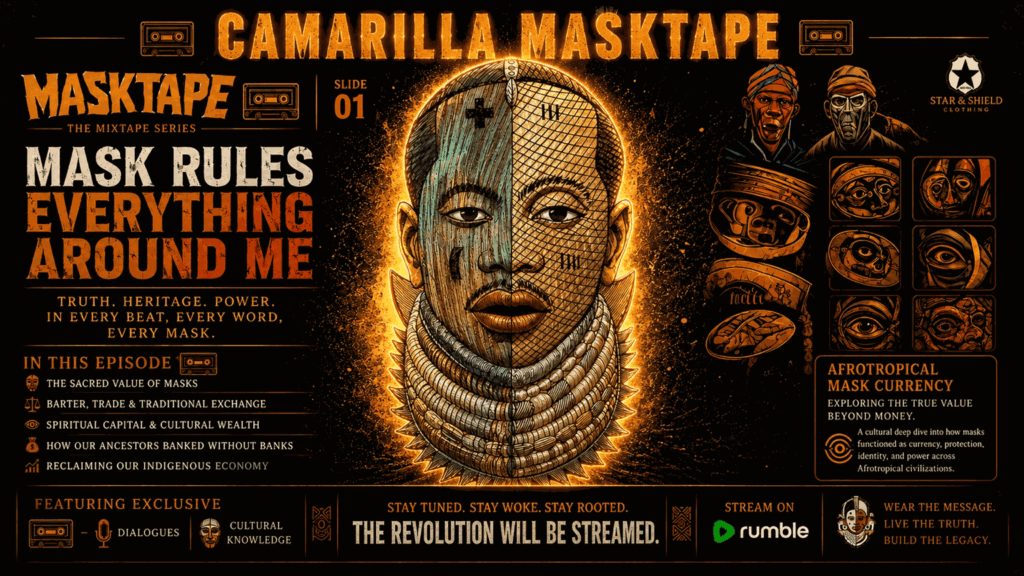
The Camarilla Mask™️ Masktape returns with Series 2, taking listeners deeper into the sounds, stories, symbols, customs, and consciousness surrounding the Afrotropical Mask.
This season is built as a bi-weekly listening experience, with a new episode arriving every two weeks through the end of the year and into New Year’s.
🗓️ SERIES 2 RELEASE SCHEDULE
EPISODE 01 — INTRO
🎭 Mask Rules Everything Around Me
The opening transmission. Enter the Masktape.
EPISODE 02 — +2 WEEKS
🌍 The journey continues.
EPISODE 03 — +4 WEEKS
🥁 Rhythm • Memory • Culture
EPISODE 04 — +6 WEEKS
🪶 Symbols • Ritual • Identity
EPISODE 05 — +8 WEEKS
🌿 The Afrotropical consciousness expands.
EPISODE 06 — +10 WEEKS
🎙️ Voices from the Mask.
EPISODE 07 — +12 WEEKS
🔥 Ancient wisdom meets contemporary sound.
EPISODE 08 — +14 WEEKS
🌌 Beyond the visible.
EPISODE 09 — +16 WEEKS
👁️ The Mask reveals another layer.
NEW YEAR SPECIAL — SERIES 2 FINALE
🎭 MASK RULES EVERYTHING AROUND ME
A final transmission closing the year’s journey and preparing the way for what comes next.
Every two weeks, another piece of the transmission.
No rush. No imitation. No counterfeit.
The Masktape is a cultural audio journey through Afrotropical culture, ancestral wisdom, music, art, symbolism, memory and consciousness.
MASK RULES EVERYTHING AROUND ME.
🎧 Camarilla Mask™️ Masktape — Series 2
Curated by Tékpwfárì Stìx Él Rà
The Kilaminjaro Afrotropical Masktape
Follow CamarillaMask.com for episode announcements, artwork, stories, and new transmissions.


The wait is almost over.
The Camarilla Masktape™ returns with Series 2, opening a new chapter in the conversation between culture, consciousness, history, creativity, and the true meaning of wealth.

This is more than a mixtape.
It is a cultural transmission.
Curated by Tékpwfárì Stìx Él Rà, Series 2 begins with an exploration of Afrotropical Mask Currency—the idea that the wealth of our people was never only measured in money.
Before modern financial systems, communities built value through trade, craftsmanship, ritual, knowledge, relationships, symbols, land, labor, ancestry, and cultural institutions. The mask could carry meaning far beyond its physical form: a vessel of memory, identity, authority, transformation, and ancestral knowledge.
The Camarilla Mask tradition presented through this series approaches the mask as a living cultural language. The Camarilla Maskbook™ similarly describes its work around Afrotropical artifacts, the 16 Tribes®, and the development of “mask consciousness.”
Series 2, Episode Intro asks:
What if wealth was never just currency?
What did our ancestors consider valuable?
How did knowledge move?
How were relationships, skills, art, ritual, land, craftsmanship, and tradition exchanged?
And what happens when a people begin to recognize cultural knowledge itself as wealth?
From the marketplace to the sacred grove, from the village artisan to the modern entrepreneur, the conversation continues.
The mask becomes the currency. The story becomes the transaction. Knowledge becomes the wealth.

Expect powerful dialogue, original beats, cultural commentary, ancestral perspectives, Afrotropical philosophy, and conversations designed to awaken consciousness.
This isn’t nostalgia.
This is cultural reconstruction.
This isn’t simply looking backward.
It’s asking what we can build forward with what our ancestors left behind.
CURATED BY:
TÉKPWÁRÍ STÌX ÉL RÀ
PRESENTED BY:
CAMARILLA MASK™

SERIES: 2
EPISODE: INTRO
TITLE: MASK RULES EVERYTHING AROUND ME
THEME: Afrotropical Mask Currency
“The wealth of our people was never just about money.”
Stay tuned. Stay woke. Stay rooted.
Camarilla Mask™ continues its exploration of masks as cultural memory, ancestral wisdom, identity, transformation, and consciousness.
Wear the message. Live the truth. Build the legacy.